Now Reading: Freelancing vs Remote Jobs which is better?
-
01
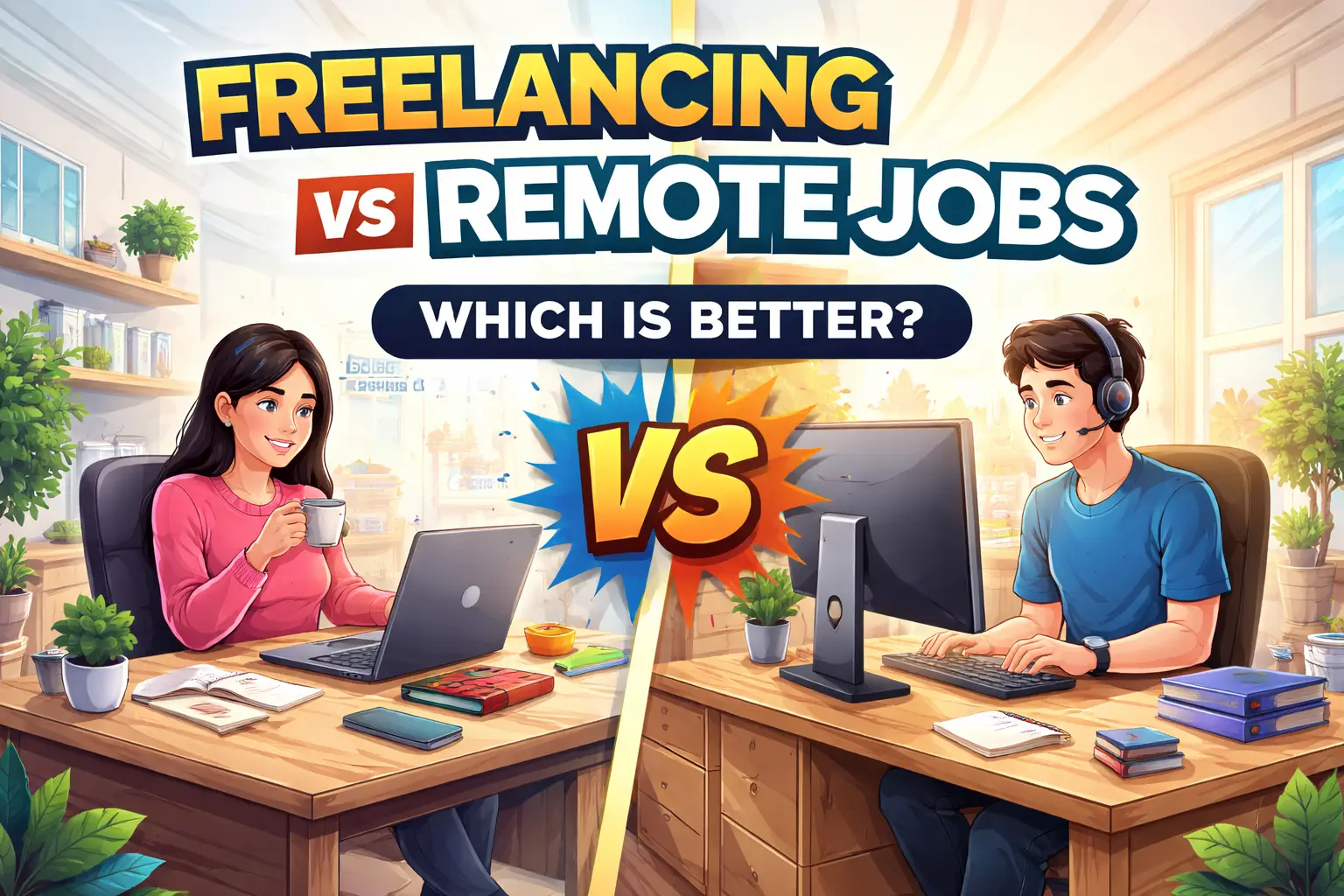
Freelancing vs Remote Jobs which is better?
Freelancing vs Remote Jobs which is better?

Understanding the Modern Work Landscape
Rise of Remote Work in 2025–2026
The way people work has completely transformed in the last few years. What was a luxury a few years ago, i.e., working from home, has now become a viable option for people to build their careers in. In 2025, 22% of the total workforce in the USA, which accounts for over 36 million people, are already working remotely, and this number is on the rise.
But what is most fascinating is that over 83% of employees want to work in a hybrid or remote work setup, citing flexibility and a work-life balance.
Imagine this: no more commuting, more time with family, and the flexibility to work from anywhere in the world. Sounds like a dream, right? But, of course, nothing in life is perfect, and there are still many challenges associated with working remotely.
Growth of Freelancing Worldwide
But now let’s discuss freelancing. It is the wild west of the job market. Freelancing is growing like never before. As of 2025, there are approximately 1.57 billion freelancers in the world. They contribute to the economy in a huge way.
The gig economy is valued at over $582 billion and is growing rapidly.
In freelancing, you get something which remote jobs can’t offer—you get complete freedom. But with freedom comes insecurity. No fixed pay, no fixed work, and no security.
But the question remains the same. Do you want freedom or security?
What is Freelancing?
How Freelancing Works
Freelancing, in essence, means running your own mini business. You don’t work for one company; instead, you have multiple clients and work on multiple projects. You might design a logo today, write an article tomorrow, and handle social media the next day.
The advantage of freelancing lies in the fact that you have control over:
- The company or person you choose to work with
- The amount of money you charge
- The time of day or night you choose to work
However, the downside of freelancing lies in the fact that everything depends on you. If you don’t get clients, you won’t earn. If your client delays payment, your money will be delayed too. It’s like being the captain of your own ship, but also being the crew.
Popular Freelancing Fields
Freelancing can be in any field. However, some of the most in-demand freelance fields include:
- Web development and programming
- Content writing and blogging
- Graphic designing
- Digital marketing
- Video editing and animation
Interestingly, about 36% of freelancers specialize in web design.
What is a Remote Job?
How Remote Jobs Work
A remote job is like a regular job, but instead of commuting to an office, you get to stay at home and work. You’re still an employee, which means:
- You get paid a salary
- You have to follow the company’s rules
- You have to work a set number of hours
It’s like a regular job, but with the flexibility of working from anywhere.
Industries Offering Remote Jobs
Remote jobs can be found in many industries, including:
- IT and software development
- Customer support
- Marketing and advertising
- Finance and consulting
- Education and online teaching
Many companies today are opting to hire remote employees to help them cut costs and tap into a global talent pool.
Key Differences Between Freelancing and Remote Jobs
Income Stability
This is where the biggest difference lies. Remote jobs offer consistent income, while freelancing income can fluctuate wildly.
| Factor | Freelancing | Remote Jobs |
|---|---|---|
| Income | Unpredictable | Stable |
| Payment | Per project | Monthly salary |
| Risk | High | Low |
Freelancers can make more, but they can make nothing in a bad month.
Flexibility and Freedom
Freelancing wins here, no doubt.
- Freelancers choose their schedule
- Remote workers follow company timings
If you want total control over your day, freelancing is your best bet.
Job Security
Remote jobs provide job security, benefits, and legal protection, while freelancing provides none of these.
Think of freelancing like a roller coaster—exciting but risky.
Work-Life Balance
This one is tricky. Remote jobs can sometimes feel like you’re “always working,” while freelancers can struggle with overworking to meet deadlines.
Interestingly, studies have shown that remote workers can feel lonely and even get burned out, especially when fully remote.
Pros and Cons of Freelancing
Advantages of Freelancing
Being a freelancer is like having unlimited potential. It means you can earn as much as you want, depending on your skills and your willingness to work.
- Unlimited earning potential
- Ability to choose your own clients
- Flexible work hours
- Ability to establish your own brand
This is because many freelancers experience high levels of happiness because they control their work life.
Disadvantages of Freelancing
But let’s be real, it’s not easy.
- No stable income
- No benefits (health insurance, paid time off)
- Client dependency
- High competition
In fact, about 80% of freelancers experience difficulties with unexpected expenses because of the lack of stable income.
Pros and Cons of Remote Jobs
Advantages of Remote Jobs
The best part about working from home is the comfort and security associated with the job.
- Fixed pay
- Job security
- Flexibility to work from home
- Company perks
You do not have to chase clients or worry about the pay.
Disadvantages of Remote Jobs
But, as is the case with everything, the cons of working from home also exist.
- Lack of freedom
- Fixed working hours
- Lack of control over the project
- Potential for stagnation
Some people also feel alienated from the team.
Freelancing vs. Remote Jobs – Salary Comparison
Now, let’s compare these two in terms of salaries. Here are some comparisons:
- Freelancers can earn between $15 and $132 per hour depending on skill levels.
- Some of the best freelancers can earn more than $100,000 per year.
- Employees in remote jobs earn fixed salaries. Their salaries even increased by 4.4% compared to on-site workers.
So, freelancing has higher earning potential—but remote jobs offer consistency.
Which is Better for Beginners?
For those who are new to the job market, remote jobs are more recommendable. Why?
Because you:
- Gain valuable experience
- Learn from a structured environment
- Earn a stable income
On the other hand, freelancing demands skills, confidence, and connections.
Which is Better for Long-Term Career Growth?
It depends on your objectives. Here are some examples:
- Want job security and promotions? → Remote job
- Want financial freedom and scalability? → Freelancing
Some even start from remote jobs then transition to freelancing later on in their careers.
Hybrid Approach – Best of Both Worlds
Here’s a smart idea:
Why not do both? Why not have the best of both worlds?
The idea is to start from remote jobs then transition to freelancing. Why? Because:
- You earn a stable income
- You earn from your own business
- You minimize financial risk
Today, more professionals are adopting this hybrid approach. Smart, right?
Final Verdict – Which One Should You Choose?
The choice between the two is simple:
Choose freelancing if:
You want freedom
You want flexibility
You want high income potential
Choose remote jobs if:
You want job security
You want job stability
You want consistent growth
There is no one-size-fits-all answer. It depends on your personality, risk tolerance, and goals.
Conclusion
The choice between freelancing and remote jobs is not about which one is superior. It is more about which one suits your lifestyle. The world has changed, and the workplace has changed too. It is not a place where you have to stick to the norms anymore. You can experiment, change, or even combine both options. Freelancing can give you wings, and remote jobs can give you roots. The choice is yours: do you want wings or do you want roots? Or maybe, you want both? Why not?
FAQs
1. Can I have both, i.e., do both freelancing and remote jobs?
Yes, you can have both. It is called a hybrid approach. Having both can help you balance your income and risk.
2. Which one pays more: freelancing or remote jobs?
Freelancing pays more, but remote jobs provide a steady income.
3. Is there any risk in freelancing?
Yes, there is a risk of income uncertainty in freelancing, and there is no job security.
4. Is there job security in remote jobs?
Yes, remote jobs provide job security, stability, benefits, and legal protection.
5. Which one is more suitable for students?
Freelancing is more suitable for students


Stay Informed With the Latest & Most Important News
Previous Post
Next Post
Previous Post
Next Post











Advertisement